Aug 21, 2026
A Mental Model for Inflation
What to picture when you hear the number, and how to turn it into a trade idea
 Omar Hussain
When you hear about inflation, it is the news media telling you a number and whether it went up or down. It leaves you with more questions than answers.
It happens to me too. But I have a mental model on my wall that forces me to ask the important questions: where did this actually come in, and what are the second-order effects. It is part of a broader top-down process of mine when generating trade ideas.
So when you hear about inflation, you should think about the value chain.

Why we look at this: it shows how goods and services stream through the inputs toward the consumer. It is a simplified mental model of how profits are made through the value chain. Every node buys at one price and sells at a higher one, and that gap is their earnings.
Look at the two ends. The consumer pays $10.00. The raw input costs $1.00. The other $9.00 is spread across four businesses as profit.
So when a cost goes up anywhere in that chain, at the commodity, the manufacturer, the wholesaler or retail, the price the consumer pays does not simply move with it. The increase has to travel through every business between that point and the consumer, and each one decides whether to pass it on or absorb it.
The two categories of inflation
Cost-push inflation. Rising costs for businesses, labor and production, cause prices to rise. From wherever the cost lands, it pushes forward toward the consumer.
Demand-pull inflation. Increasing demand causes prices to rise. From wherever the demand sits, it pulls backward toward the commodity.
Put both of them on the same picture and it looks like this.
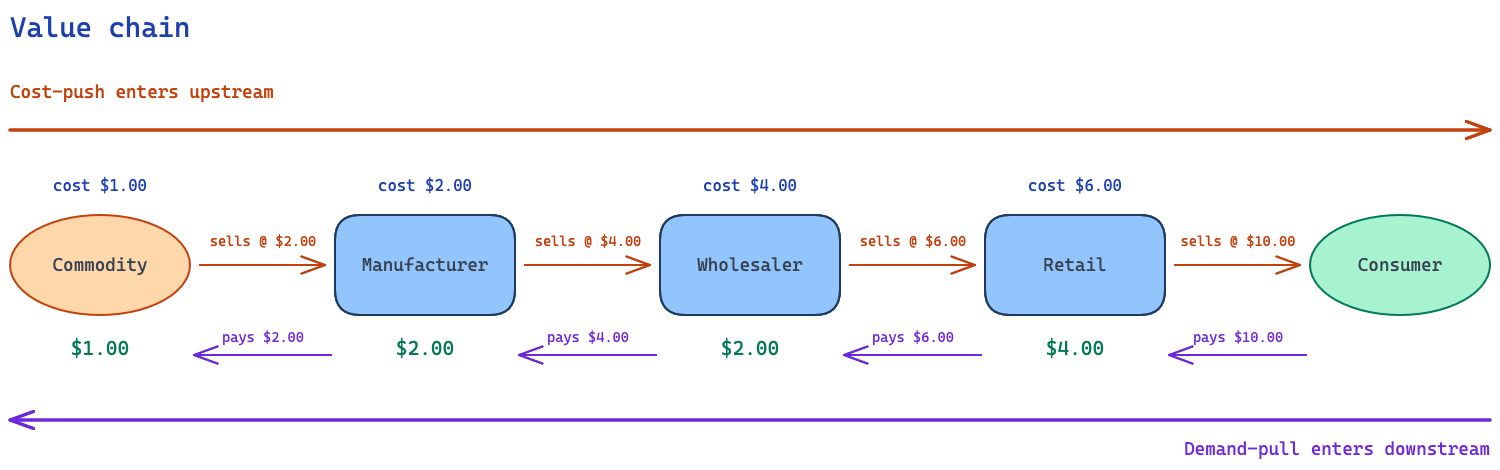
So you need to ask which one is driving it. Cost-push, demand-pull, or even a combination of both. The headline number reads the same either way, so you work it out from the way it moves through the chain. Three things separate them.
| Cost-push | Demand-pull | |
|---|---|---|
| Which way does it move | Forward, downstream toward the consumer | Backward, upstream toward the commodity |
| Reaches the next business as | Higher costs | Higher revenue |
| What you check | Can they pass it on? | Do they have the capacity to meet it? |
Some examples of cost-push:
Tariffs, 2025-2026. A tariff is charged the moment goods cross the border, so the cost lands early, before the manufacturer has touched them. Whoever imports pays it first, then decides how much of it the next buyer sees.
Energy and the Iran conflict, 2026. This one starts at the very beginning. Energy is a raw input, so the cost lands on the first business in the chain and everyone after it has to carry it.
European gas and power, 2022. The same thing, with a different cause. That is what makes it worth remembering: when energy moves, you already know which end of the chain to start looking at.
And for demand-pull we have:
Pandemic stimulus, 2020-2021. Cash landed directly in the consumer.
Post-lockdown travel and services, 2022-2023. Airfares and hotels, where capacity was fixed and willingness to pay had built up for two years.
AI data center demand, ongoing. Companies are pointing to demand from AI data centers alongside tariffs and energy as reasons inflation stays above target. Look at who else needs power, chips and construction. They did not see demand rise, they saw their input bill rise.
Where the return is
Figuring out what causes the inflation is the first half. More important is what the second-order effects of that initial reaction are.
When these events occur, you should already begin to think:
How does this initial reaction affect inflation, and where does it show up in the value chain?
From there, what are the short and long term effects?
How does that impact different industries, and in turn affect their revenue and earnings?
Referring to this mental model picture and applying second-order thinking to generate trade ideas is what generates outsized returns for your portfolio.
So next time a major event happens in the world, think about the value chain and where it gets affected, and leverage that to generate your next trade idea.
Keep Reading
Aug 14, 2026
GAV vs NAV: Where the Fees Are Calculated
What sits between the two numbers, and why it is never one calculation
Omar Hussain
Aug 7, 2026
Side Pockets: A Hedge Fund Invention
Redeeming from a fund that holds private companies gets you the liquid half. The rest stays invested, and keeps charging you.
Omar Hussain
Jul 31, 2026
The Capital Account
What the fund reports, and what you actually hold
Omar Hussain